FTDNA East Anglia

Family Tree DNA Social Photos 4498710 (849×501)


‘Sheep stealers from the north of England’: the Riding Clans in UlsterHistory Ireland – ROBERT BELL

‘Shipped for the Barbadoes’: Cromwell and Irish migration to the Caribbean – History Ireland

Chronicles of the Armstrongs; : Armstrong, James Lewis : Internet Archive


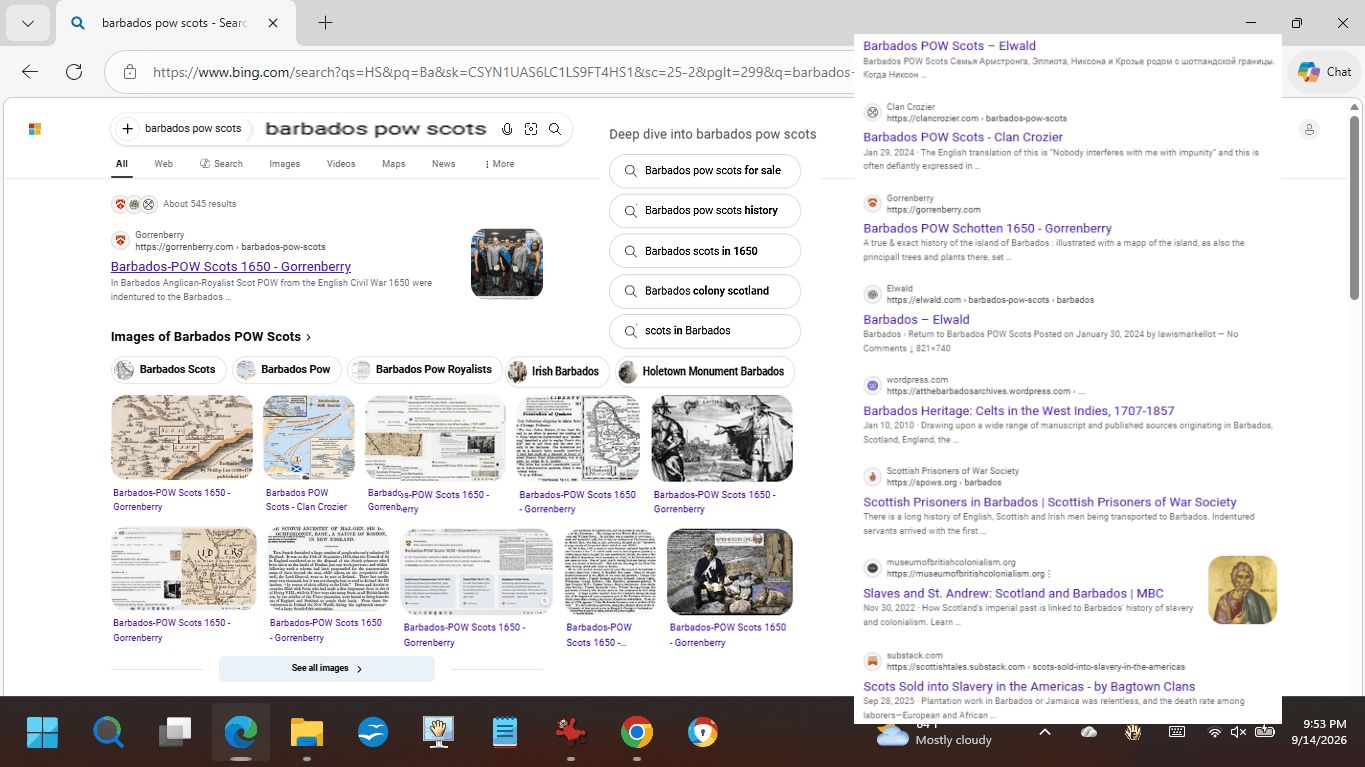
https://www.bing.com/search?q=barbados+scots

Bing Videos-Die irischen Zuckersklaven von Barbados

Genealogy Garage: Scottish Prisoners of War youtube

Involuntary Americans: Scottish Prisoners in 17th Century Maine youtube


Family Tree DNA Social Photos 3719534 (1181×912)


Rush Research by Loren S. Elliott


James Tanner und ich sind Hobby-Familienforscher der Four Corners Region (UT, CO, NM, AZ, im Uhrzeigersinn, anders als die Pawnee aus Oklahoma) in den USA. Wie Bobby Jones, der Golf spielte und den Grand Slam in einem Jahr gewann. Die Großmutter von Margaret Eliott, dem 29. Häuptling aus Redheugh, Schottland, stammte wie Bobby Jones aus Atlanta, Georgia, und auch sie gewann, wie viele ihrer Großmütter, den Grand Slam.            Mark S. Elliott 11/1/2025


The History of Liddesdale, Eskdale, Ewesdale, Wauchopedale and the … – Robert Bruce Armstrong – Google Books

Chronicles of the Armstrongs; : Armstrong, James Lewis : Free Download, Borrow, and Streaming : Internet Archive

The History of Liddesdale, Eskdale, Ewesdale, Wauchopedale and the … – Robert Bruce Armstrong – Google Books


Musical instruments. Pt. I. The Irish and Highland harps : Armstrong, Robert Bruce : Free Download, Borrow, and Streaming : Internet Archive

The History of Liddesdale, Eskdale, Ewesdale, Wauchopedale and the … – Robert Bruce Armstrong – Google Books

The harp on the royalist flag symbolizes the Gaelic-Irish-Scots. US President Donald Trump’s mother comes from this line, and golf is a Scottish game. The Gaelic-Irish-Scots welcomed us border dwellers after the death of Queen Elizabeth I.  Robert Bruce Armstrong published books on the harp and the Scottish-English Border.


The History of Liddesdale, Eskdale, Ewesdale, Wauchopedale and the … – Robert Bruce Armstrong – Google Books


The exploration of the Colorado River and its canyons : Powell, John Wesley, 1834-1902 : Free Download, Borrow, and Streaming : Internet Archive

Canyons of the Colorado, or The exploration of the Colorado River and its Canyons : John Wesley Powell :Chapter 14 To Zuñi mp3.


Исследование реки Колорадо и ее каньонов : Пауэлл, Джон Уэсли, 1834-1902 : Бесплатная загрузка, заимствование и потоковая передача : Internet Archive

Страница 158

Хотя некоторые из его спутников утонули, Эшли и еще один выжили, взобрались на стену каньона и нашли путь через горы Уосатч в Солт-Лейк-Сити, питаясь в основном ягодами, пока они блуждали по незнакомой и трудной стране. Когда они прибыли в Солт-Лейк-Сити, они были почти лишены одежды и почти голодали. Мормоны давали им пищу и одежду и нанимали их для работы на фундаменте Храма, пока они не зарабатывали достаточно, чтобы уехать из страны. Об их дальнейшей истории я ничего не знаю. Возможно, они вернулись на место катастрофы, так как небольшой ручей, впадающий в реку внизу, известен как ручей Эшли, и сообщается, что он построил хижину и застрял на этой реке на одну или две зимы; Но это могло быть до катастрофы.


Those New Zealand grandmas certainly know you to look after you.


A Vermont Moose Visits Paris in 1787

Durham NH Archives – New England Historical Society


FTDNA genealogy


Gordon, Alexander


Alexander Gordon & Daniel Elliot, Ulster to Maine c.1650


About us


CURRENT BRANCHES & HISTORICAL RESEARCH
The estimated Time to Most Recent Common Ancestor (TMRCA) for these branches is about 700 years before present (ybp) or around 1300 AD
The heat maps for the Jackson, Lee and Waugh surnames indicate an overlap in what was the Kingdom of Northumbria that was invaded by the Vikings “Great Heathen Army” c 866 AD
The Viking’s “Great Heathen Army” (of “Danes” comprised mainly of men and women from Denmark and southern Sweden) invaded East Anglia in 865. “They arrived under the leadership of Ivar the Boneless and his brothers, Halfdene and Hubba and after camping the winter, turned their attention to Northumbria… One part of the huge Danish army under Halfdene continued the settlement of Yorkshire, while another took control of the East Midlands. The shires of Derby, Nottingham, Leicester, Lincoln and Stamford in the East Midlands would come to be known as ‘the Five Boroughs of the Danelaw’ while the West midlands, like Bernicia remained AngloSaxon. It was possible to talk of their being two Northumbrias and two Mercias each under the resepective influence of Danes or Angles.” – from History of Northumbria: Viking era 866 AD – 1066 AD
I-BY160105 (Jackson)
This line has traced back to James Jackson, b. abt 1790, Coleraine, Ireland, and probably goes back to the Jackson family of Carrickfergus, Antrim, Ireland (based on autosomal DNA matches and their trees). Carrickfergus was the home of the the seventh US President Andrew Jackson. Carrickfergus was also the home of Samuel Wauchope (b. about 1690) & Nancy Alexander.
Heat Map for distribution of the Jackson surname in the UK
The distribution of the Jackson surname indicates a very strong connection to Viking York and Cumbria
Jórvík
Scandinavian York (referred to at the time as Jórvík) or Danish York is a term used by historians for the south of Northumbria (modern-day Yorkshire) during the period of the late 9th century and first half of the 10th century, when it was dominated by Norse warrior-kings; in particular, it is used to refer to York, the city controlled by these kings. York had been founded as the Roman legionary fortress of Eboracum and revived as the Anglo-Saxon trading port of Eoforwic. It was first captured in November 866 by Ivar the Boneless, leading a large army of Danish Vikings, called the “Great Heathen Army” by Anglo-Saxon chroniclers, which had landed in East Anglia and made their way north, aided by a supply of horses with which King Edmund of East Anglia bought them off and by civil in-fighting between royal candidates in the Anglian Kingdom of Northumbria between the leaders of its two sub-kingdoms; Bernicia and Deira. Declaring a truce, the rivals for the throne of Northumbria joined forces but failed to retake the city in March 867, and with their deaths Deira came under Danish control as the Kingdom of Northumbria and the Northumbrian royal court fled north to refuge in Bernicia. – Wikipedia
Cumbria
Place-name[46][47][48] and sculptured stone[42][49][50] evidence suggests to one historian that the main Scandinavian colonization took place on the west coastal plain and in north Westmorland, where some of the better farming land was occupied. The warriors who settled here encouraged stone sculptures to be made. However, the local Anglian peasantry seems to have survived in these areas as well. Some, less successful, occupation of other lowland areas took place, along with, thirdly, occupation of ‘waste’ land in the lowland and upland areas. This occupation in the less-good farming areas led to place-names in -ǣrgi, -thveit,, -bekkr and -fell, although many of these may have been introduced into the local dialect a long time after the Viking age.[51] “Southern Cumbria”, including the future Furness region (Lonsdale Hundred) as well as Amounderness in Lancashire, was also “entensively colonized”.[52]The occupation was likely to have been largely by the Norse between about 900 and 950, but it is unclear whether they were from Ireland, the Western Isles, the Isle of Man, Galloway, or even Norway itself. Just how peaceful, or otherwise, the Scandinavian settlement was remains an open question. It has been suggested that, between c. 850 and 940, the Scots on the one hand, and the Norse of the Hebrides and Dublin on the other, were in collusion as regards what seems to have been peaceful Gaelic-Norse settlement in west Cumbria.[53] It has also been suggested that the Hiberno-Norse in Dublin were prompted to colonise the Cumbrian coast after being temporarily expelled from the city in 902. The successful attempt by Ragnall ua Ímair to conquer the Danes in York (around 920) must have led to the Dublin – York route through Cumbria being frequently used. In Westmorland, it is likely that much colonization came from Danish Yorkshire, as evidenced by place-names ending in -by in the upper-Eden valley region (around Appleby),[54] especially after the eclipse of Danish power in York in 954 (the year of the death of the Norse King of York, Erik Bloodaxe, on Stainmore). – Wikipedia
I-BY70495 (Lee)
One of our BigY FGC21765 matches has traced his ancestry from Virginia (“Hancock Lee, son of Richard the Emigrant”) back to Nordley, Shropshire, England (not far from a place called Danesford), to about 1617. The Vikings were in Shropshire along the River Severn from at least around 893-896. See Richard Lee in Alfred the Great’s Lineage, Richard Lee I and Lee Family Member FAQs. A new SNP BY70495 has been identified by FTDNA under FGC21765 (June 15, 2018) for this line. The TMRCA for I-FGC21765 (700 ybp) indicates that the common ancestor pre-dates the use of surnames.
“In 896 the Danes stayed here briefly during a raid and the Saxon Chronicles state that ‘they made their way overland until they arrived at Quatbridge on the Severn, and there constructed a fort. They then sat that winter at Bridge’. The Danes were not allowed to build a permanent settlement as Ealdorman Aethelred kept harrying them on behalf of King Alfred until they moved on…. The Domesday Book entry for this area records only a new house and borough yielding nothing, ie no rents. No mention is made of a bridge so, having been replaced in importance by the one at Bridgnorth, it is likely that the Quatford bridge had fallen down or been washed away. It was probably as a result of this that the name Quatbridge became Quatford. Earl Roger Montgomery built a timber castle there in 1085 and it would be an obvious thing to reuse an existing fortification. Any trace of the Danish occupation would have been destroyed when building the Norman fortification. A documentary source records that the settlement of Quatford was transferred to Bridgnorth in 1102, when Robert de Belmese established his castle there.” – From  Danish Shropshire
“The Lee family of Virginia and Maryland has been found to belong to haplogroup I1-L22 > P109 > S10891 > Y13930 > Y14227 > Y14225 based on descendant testing. Famous members include Richard Lee I (1617–1664), founder of the family and wealthy landowner, Richard Henry Lee (1732-1794), one of the Founding Fathers of the United States, and General Robert E. Lee (1807-1870), who was commander of the Confederate States Army during the American Civil War.” – Eupedia
Heat Map for distribution of the Lee surname
I-S7005 (Waugh)
One of our BigY matches goes back to a Lyman Waugh (1814-1882) of Jefferson County, New York. Lyman Waugh may be a descendant of the Waughs of Litchtfield, Connecticut, and it’s not known where these Waughs originated but based on the closeness of the match and the surname they were probably from the Border area between Scotland and England within what was once the old Kingdom of Northumbria
“Waugh” (foreigner) was the name given to Scandinavian settlers by the Anglo-Saxons of Northumbria. Our Waugh “cousins” settled in Northumbria from the mouth of the River Tyne to the rich fishing and farming area around the Solway Firth in Cumbria and Dumfriesshire. Place-names and archaeological evidence confirm a strong “Norse” (Scandinavian) cultural presence throughout these areas. A recent “Viking hoard” discovered in Galloway and Dumfriesshire attests to the wealth of some of the Norse inhabitants.
Heat Map for the distribution of the Waugh surname in the UK


I-FGC21763 (Waugh)

This branch represents the Waugh family of Dumfriesshire, Scotland…

“Tinwald (Thing Völlr) ‘field of the meeting’
– a short way N.E. of Dumfries (on the Roman Road from Lochmaben) seems to have been, as its name suggests, the centre of local Norse control”Tinwald, DumfriesshireIn 840 Alcluyd (the Pict and Scots kingdom) fell after a siege of four months by Danes and Norse. Five years later Halfden with his Danes traversed the country into Northumbria and is recorded to have wasted the Strathclyde Welsh, or Strathclydians, or as in a third place, and for the Cumbri. This was an enterprise of Danes from Ireland and does not seem to have been more than a foray of exceptional destructiveness… Permanent settlement was the work of the Norse-bearing elements of Irish culture. Tinwald (Thing Völlr) ‘field of the meeting’ – a short way N.E. of Dumfries (on the Roman Road from Lochmaben) seems to have been, as its name suggests, the centre of local Norse control – the first serious settlement would be in Cumberland …” – from “The Royal Commission of Ancient Historical Monuments and Constructions of Scotland,” Edinburgh, 1920, Historical Introduction XVIII, Early History II, Page XX, see back page XXIII (as per David Jardine).

Viking legacy in the names

The name Middelby was recorded in about 1280, middel was the Old English/Danish Norse form of middle. It has been written that Middlebie took its name, signifying the “middle dwelling” or “middle station” from the Roman Camp of Birrens south of the village, and midway between Netherbie in Cumberland and Overbie in Eskdalemuir. However there are nine places ending -bie or -by in the Dumfries area and it is a frequent suffix in the north of England. James B. Johnston tells us that this indicates that Danish Vikings were in this area. These name endings derive from the Old Norse by-r and Icelandic boe-r meaning a dwelling, hamlet or town. Middlebie lies within Annandale, the suffix -dale derives from the Norse dail meaning a field or meadow. The main rivers running through the parish are the Mein Water and the Kirtle Water which reach the sea via the Solway Firth, firth being the Norse word for estuary. The -beck of Waterbeck is Icelandic/Danish for a brook, and rigg from the same language is a ridge of land. Satur derives from the Norse word saetor meaning summer pasture. – from Middlebie Parish History Group Website

Norse Sites in Galloway & Dumfriesshire
Historical distribution of Waugh surname (blue dots) in Dumfriesshire
From Norse Sites and Viking Hoards in the Irish Sea & Western Britain

Guy Hewitt: Barbados remembers Scots heritage on St Andrew’s Day (scotsman.com)

Guy Hewitt and myself Mark S. Elliott YSEQ 4069 FTDNA 101829 of Daniel group could easily match on first twelve markers.

FTDNA-101829-autosomal-Y-DNA-mtDNA.jpg (1226×944) (elwald.com)


Eliot Surname Origin, Meaning & Last Name History (forebears.io)

Discover the Eliot family with Your Family History (your-family-history.com)


Chronicles of the Armstrongs; : Armstrong, James Lewis : Free Download, Borrow, and Streaming : Internet Archive

Daniel Elliot (1637–1704) • FamilySearch


Cambridge University Press & Assessment
https://www.cambridge.org/core/services/aop…

The People of the British Isles Project and
Viking settlement in England
Jane Kershaw (j.kershaw@ucl.ac.uk) and Ellen C. Røyrvik
(e.royrvik@warwick.ac.uk)


Cambridge University Press & Assessment
https://www.cambridge.org/core/services/aop…

The People of the British Isles Project and
Viking settlement in England
Jane Kershaw (j.kershaw@ucl.ac.uk) and Ellen C. Røyrvik
(e.royrvik@warwick.ac.uk)

Россия — это большая территория, на которой проживает множество людей разных культур. Люди мигрировали. Переселились не те, которые воюют, а те, которые переселились в поисках лучших условий. Ветвление идет из Африки на Ближний Восток.

Арабский и иврит идут слева направо, поэтому они разветвлены и, вероятно, религиозно разветвлены.
Русский идет справа налево, а все языки, мигрирующие на запад из России, идут слева направо. Математика арабов более универсальна как язык.

Люди, медведи, волки и лоси встречаются в Азии и Америке, а имена используются в Азии и Америке для мигрирующих людей.

Англо-саксы мигрировали, что не значит, что они были завоевателями. Моя семья была шотландским военнопленным во время Кромвельской гражданской войны, продана в качестве залога кромвельским пуританам, и все же мы те, кто в Америке и Австралии, где сейчас находится FTDNA.

Кузены, вступившие в смешанные браки с ирландцем, Ко Фермана, переехали в Западную Германию во время Смуты, конфликтов между пресвитерианами и католиками, из городов далеко на севере Ирландии, чтобы превратить наши земли в поле битвы, поэтому мы переехали в Германию. Если на этой границе снова возникнет насилие, ожидайте, что Армстронг и Эллиот снова мигрируют в Германию с обеих сторон ирландской границы между ЕС и Брекситом.

ДНК путешествует вместе с языком. Если бы Рим завоевал этот язык, то Англия говорила бы на латыни. Если бы норманны завоевали этот язык, в Англии говорили бы по-французски. Победители демонизируют историю проигравших, чей язык и ДНК унаследованы.

Моя семья англо-саксонская русская, из Украины, откуда родом ваша семья. Сначала язык был бесписьменным, но фонетически нас называли лосями. Когда к фонетике были добавлены иероглифы, для лося появились разные варианты написания, хотя на диалекте они произносились в основном одинаково. Это было в районе обитания лосей в Евро-Азии.

Как только лоси вышли за пределы своей среды обитания, как это часто бывает при переходе в район Берлина из Польши, название изменилось на лось (elk), которое также используется в Англии.
Англо-европейцы мигрировали из западной Англии-Европы, где лоси не жили, поэтому они переняли американское слово, обозначающее лося (moose)…
https://www.v-stetsyuk.name/ru/Topo/Eng.html

Distribution of monuments of Late Bronze Age cultures on the territory of the southwestern zone of forests and forest-steppe of the Russian Plain and the Carpathians
Распространение памятников культур поздней бронзы на территории юго-западной полосы лесов и лесосте¬пи Русской равнины и Карпат

Children of Fair Bear; Bear, Elk (moose) and Wolf (wilk). Danish Y-DNA of Bear I-M253, Elk (moose) R-U106, and Wolf (R-L193 ?) .


Mom’s dad Stephen (from Austro-Hungarian Galicia dad Stefan) can’t stop listening to former Galician Jews, although Arthur Miller-Muller used the play “The Crucible” for freedom of speech. Grandfather Daniel Elliott, with whom I share Y-DNA, testified on behalf of Elizabeth Proctor. Harvard was a school of Puritan education. Daniel Elliot was probably half Native American according to my DNA. In testing this concept, the puritan Harvard changed their concept of whether they listen to people like genetic scientists who share differences in thinking by speaking freely.

Папа мамы Стивен (из австро-венгерской Галиции папа Стефан) не может перестать слушать бывших галицких евреев, хотя и Артур Миллер-Мюллер, использовал пьесу «Горнило» для свободы слова. Дедушка Дэниел Эллиотт, с которым я делюсь Y-ДНК, дал показания в защиту Элизабет Проктор. Гарвард был школой пуританского образования. Вероятно, согласно моей ДНК, Дэниел Эллиот был наполовину коренным американцем. При проверке этой концепции пуританин Гарвард изменил свою концепцию, прислушиваются ли они к таким людям, как ученые-генетики, которые разделяют различия в мышлении, говоря свободно.


PoBI Viking settlement in England by Jane Kershaw & Ellen C. Royrvik


LivingDNA 45% on Viking measurement. Mark Stephen Elliott, New Mexico, USA.


https://www.historyireland.com/sheep-stealers-from-the-north-of-england-the-riding-clans-in-ulster-by-robert-bell/

The Elliot is likely an Armstrong relation, they were good neighbors to Gorrenberry. At least the oldest Thomas Armstrong of Mangerton, a younger brother called Gilnockie, got some Elliot hung, as part of his gallant company. Shows those older brothers have to keep an eye on their younger brothers, if they have them. What Elliot would want to claim relations to those Graham, Irving, Johnston, and Little. They were not the best of people like those Armstrong.


DNA是用于寻找家庭成员的众多工具之一。


ДНК — один из многих инструментов, используемых для поиска членов семьи.


DNA is one of many tools used to find family members.


Elliot Chief receives a tribute to her grandmothers at Greenville, SC

Forty-eight Elliot Clan Society members participated in the Chief ís Dinner on Saturday evening during the Greenville Games.

During dinner, Elliot Clan Society member and South Carolina re-enactor, William Grissop, of Travelers Rest, South Carolina delivered a moving tribute to the Chief – honoring her Scottish Border and Southern Grandmothers. The Elliot Chief descends from a line of hereditary Chiefs back to the time of Robert the Bruce in the 1300s in Scotland. Through her Atlanta-born paternal grandmother, she also descends from many early South Carolina families who settled in that state before the American Revolutionary War. Here are the words Mr. Grissop shared with Margaret Elliott of Redheugh: Margaret Eliott is a daughter of the Scottish Borders, that fabled land that produced the men known as the Border Reivers or the Steel Bonnets. They were indeed men of steel. It need not be doubted that these men of steel sprang from, married and fathered women of steel. To even read casually of the Border history would make one wonder what sort of women were these who mothered, married and supported these men, the Steel Bonnets. These were strong women, resilient women, loving women. Were it not so, we of the Elliot Clan would not be here today. Our Chief, Margaret Elliott, is blood and sinew of these people. She is also blood and sinew of another proud line of strong women. Chief Margaret is also a Southern Girl! Her paternal grandmother was bornin Georgia and other grandmothers were born in South Carolina and Tennessee. (Being a native South Carolinian with much Georgia blood flow ing through my veins, I can readily state that this is about as much glory as one person can stand!) These women of the South have proven their glorious worth over the years.

Section B Bethís Newfangled Family Tree August 2008 Page 3
https://docplayer.net/45727391-Flagstaff-arizona-welcomes-macbains.html


John Boulton Dungannon Lord Viscount Powerscourt Tyrone c1630 Muster Rolls (therjhuntercollection.com)

November | 2022 | DNAeXplained – Genetic Genealogy (dna-explained.com) Gisburn

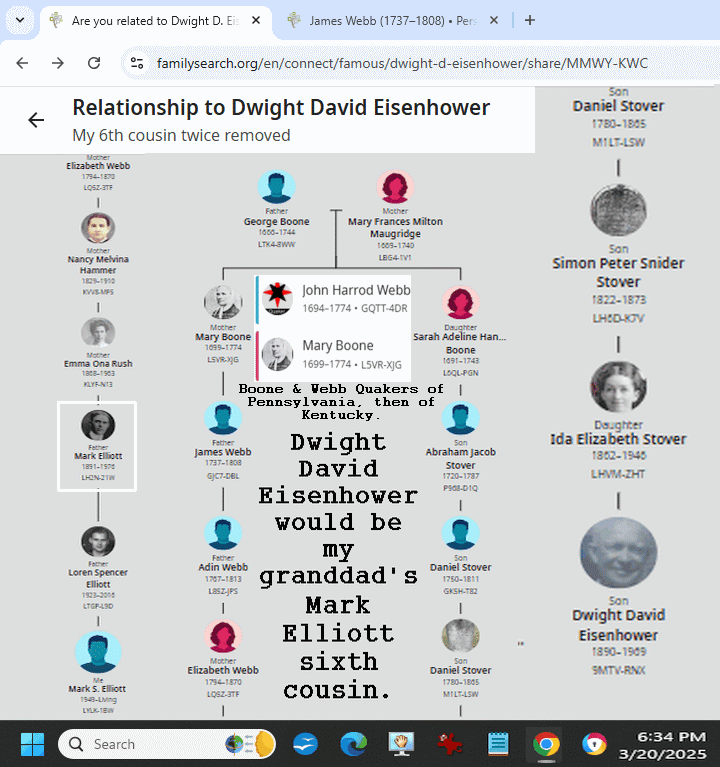
Memorials in Twiston Quaker Burial Ground – Find a Grave

Lancastria Atlas Christopher Saxton in 1576


Use to using a different format, but the above is and example of lands, including an insert-map showing Braidlee, from Anglo-Saxon Broadlee, meaning a valley broad on the leeward side. Wolflee also Anglo-Saxon, meaning the valley of the wolf. Yes, there were wolfs in the region. They introduced them around here and the Navajo grandmas shoot them for going after their sheep. Put chief Margaret Eliott raised in Stobs, but of Redheugh, in the same category if Scotland decides to reintroduce wolfs. Her husband seems to have a Polish wolfish type surname.

Though I may observe him, do not want to make any distinctive moves. Past British Army MI6 you know, but on the same family side.

May have bumped elbows on an Armstrong in the Aberdeenshire region. Finding that Eliott-Elliot may have land connection with Douglas-In-graham in region. Those Graham they are English an seem to not want to claim Armstrong-Elliot as family. Maybe the Nixon and Crozier seem to have English connections they find more acceptable.

Kind of like staying in the Forest with the Fosters, they are English and seem to be not offended to be related to Armstrong and Elliot, from the English side like those Grahams. It is the Hunter and wolf, for they are predators of the elk-moose, I must watch out for.

The Crozier seem to be Saxon along with the Thorleehope (valley of Thor, god of lightning Thunder Valley). A couple of Crozier seem to match their Y-DNA and are not R-L193. It seem like if you are not R-L192 and are R-U106, Anglo-Saxon they like to silence and exterminate you. Mark Stephen Elliott

Daniel as a forename is not popular in Scotland. Many great in accordance with Douglas Scott of BC, Canada, Dand Ellot was banished from both Kingdoms in 1607, then shows up as Daniel Elliott, in Tullykelter, Co. Fermanagh, Ireland, as part of the Somerville Estate in-law to the Monea Hamilton. Names Somerville, and Ellott show up in 1610 Tyrone Muster, and a generation later in the Co. Fermanagh, Muster. James Somerville shows up in bother musters. 1610 James Somerville had son 1630 Somerville. Scots alias nickname for Andrew is Dand, Irish English it becomes Daniel from surname of Daniel-M’Daniel it may be obtained. Ellot family of Tullykelter were Anglican but nomally Catholic, from forenames show this, even the name in 1610 Ulster Muster of Co. Fermanagh, Marke Ellot shows this. Before 1650 the Scots used Ellot not Elliot with the Norman ‘i’. Daniel Elliott name in 1692 Salem Trials was spelled Elot, the ‘i’ was added likely because of a John Eliot (Eliot Hall Harvard) which came over on the Mayflower. Had a relative to a George Soul who’s ancestor those Armstrong may have melted in lead at Ninestanerig, 9 stone ridge. Did not seem to care much for this Soulis either. The Douglas and Armstrong seem to like, and this Douglas Scott who is from BC, Canada is active with the Hoik-Hawick Archaeological Society, and has this younger brother who is active also, and sings Scottish Ballads with this group called Scocha (Scott-Chapman), do not know being an elk-moose if I care for his middle name of Hunter, though I think he also is weary of the hunter.

A Hawick Word Book Douglas Scott.pdf (ubc.ca)

Wind farm battle over Scottish castle

A-1 Clade de Glendonwyn-surnames  (gorrenberry.com)


YORKSHIRE East Riding BRIGHAMS

The history of the Brigham family; a record of several thousand descendants of Thomas Brigham the emigrant, 1603-1653 : Brigham, Willard Irving Tyler, 1859-1904 : Free Download, Borrow, and Streaming : Internet Archive


Chronicles of the Armstrongs; : Armstrong, James Lewis

https://maps.nls.uk/atlas/blaeu/

Glendonwyn A1-Clade-Report (elwald.com)


Brigham ‘This is the Place’ genealogy with DNA applied

Global web icon
elwald.com
https://elwald.com/az-photo-radar

AZ Photo Radar – Elwald

The History of Liddesdale, Eskdale, Ewesdale, Wauchopedale and the … – Robert Bruce Armstrong – Google Books

Redheugh-Larriston-Hartsgarth-Liddesdale sassine-dead from Archibald ‘Bell the Cat Douglas’ V earl of Angus.

In the Russian-speaking environment, there is a version that the battle “Tollense valley battlefield” is supposedly a conflict over the genetic border between distant genetic relatives R1b and R1a. In the battle, the earliest Europeans from genetic genus I (i) were used as allies and support for the R1b cavalry. Allegedly, in the Bronze Age, there was a prototype of the Warsaw Pact, which protected Eastern Europe R1a from other different religions, ideologies, and new synthetic languages ​​… in the future, divided R1a into small pygmy states, under external control. Therefore, it is very interesting to find the primary source for genetic haplogroups determined from the bones of ancient warriors who made history, which is unknown to us, since, for example, in Russia (even in tsarist Russia, perhaps due to the fact that the last Romanovs were R1b from the family Holstein-Gottorp). All historical events before the adoption of Christianity were destroyed or hidden from the public eye and education.
Mikhail Ravinski
August 23 @ 4:19pm
From a genetic point of view, it is very difficult to find out who the Russian Tsars and Princes really were, since even in the official data it is clear that the tsars were replaced in childhood. And a very vivid example is the Russian Tsar Peter 1, either he was replaced by the “Germans” in Moscow at the time of his birth, then he is actually the son of a Georgian prince, then he was changed for the third time during a trip to Western Europe. And I don’t really know who they were by genetics Holstein-Gottorp. Since everything connected with the power in Russia is covered with several layers of rewritten history. Even now, they say that Putin is not real and that there are doubles acting instead of him, or in general all the presidents of Europe, the United States and Russia were infected with leprosy by the President of Ukraine Yushchenko. And because of this insidious disease, Putin’s face has changed, and in fact it is not a double, but simply a consequence of the leprosy that Yushchenko infected with during kissing and hugging all the presidents.
Mikhail Ravinski
August 23 @ 4:30pm
Bashkir cartoon based on myths that the Giants used to live together with people and why distant relatives of R1a and R1b constantly waged wars among themselves. R1a and R1b are the main haplogroups of the Bashkirs. But that’s not the point. This cartoon by Artyom Lukichev is about the epic Ural. According to this epic, the Bashkirs descend from two brothers – Shulgan and the Urals. So one of the sons of Shulgan – Hakmar – the Bashkir Burzyans descend from him, they are R1b, and the three sons of the Urals – Idel, Nugush and Yaik – from them the Bashkir tabyns, Yurmats and Kypsaks come from, they are R1a. https://www.youtube.com/watch?v=wMBuo7JHesg

FTDNA Ryedale Yorkshire to Roxburghshire

History students’ Pammel Court exhibition brings back memories – Link MagazineLink Magazine (iastate.edu)


Share Button